


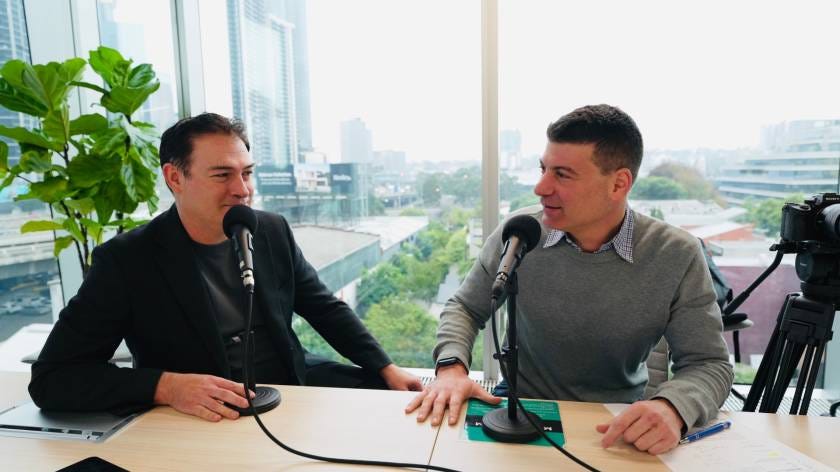
We’ve launched our most commonly requested feature - buy your tickets to a live recording of The Contrarians here. Details below:
Thursday, September 10th from 4.00 to 5.30
Hosted at The Commons, Cremorne in Melbourne
Tickets are an absolute steal at $49 (rumour has it Adir wanted to charge 100x that…)
Buy your tickets now! Expecting this to sell out quickly…
The Contrarians catchup
Adir went to DEF CON in Las Vegas, the world’s largest hacker conference. His verdict: “Once you call it InfoSec and start thinking about it bigger than ‘how is Mythos going to hack my software’, it’s a very fascinating area. Directors in Australia are deeply underprepared for this. It’s scary what ASIC has said relative to the level of sophistication.” A social engineering demo in real time showed a caller extract enough information from an unknowing company employee to theoretically run a ransomware attack, in a 20-minute phone call.
Adir also went to San Francisco for the first time since COVID. Figma is the most prolific advertiser in the city, with 40 Figma ads for every one Canva ad. And every single billboard on Highway 101 has either “AI” or “API” on it. “If you’re in tech, you need to go to San Fran because number one, it will be invigorating. Number two, you see the future.”
Adir rode in a Waymo in San Francisco after previously riding in a Zoox in Las Vegas. His verdict: “A Waymo kind of sucks after you’ve been in a Zoox. It’s much better than an Uber with a driver. But Zoox is a step up.”
LinkedIn is throttling organic reach. Adir audited his top ten feed posts: six were “commented on by a connection” rather than posted directly by a connection. Zero of the top ten were an actual post from someone he follows. Adam: “LinkedIn’s always been one of the few bastions of organic reach. And having two out of ten paid is a pretty big change from LinkedIn.”
$13B, 100 employees, $600M ARR, and probably losing money
Swedish AI app builder Lovable is raising at a US$13B valuation. It has approximately 100 employees and around $600M in annualised recurring revenue. Its market cap per employee is roughly A$200M, compared to NVIDIA’s A$192M per employee and Coles’ A$270K. The business builds websites and apps via AI prompts, having swept past incumbent Wix.
Adir: “Lovable is a platform that basically lets you make websites. There was Wix, the Israeli business, that dominated this space. And then AI came along and said, “oh, workflow, that’s what we’re all about”. We’re just gonna go and build a native workflow simplification for websites. It’s even simpler than Wix.”
Adir: “Imagine a business that makes $400M of trailing twelve months revenue. They only have 100 employees. Those employees, what are they going to cost on average in cash? $300K a year? So almost nothing. And yet I doubt they’re profitable with $400M because of token costs. The gross profit on businesses built on top of someone else’s models are generally not amazing.”
Adir: “In the casino economy that we live in now, surely the Lovable way to grow is just: if they employ another hundred people, they’re just going to increase another $6B in market cap. Isn’t that the way the maths works? Can you reverse-engineer it?”

It’s not just software, and directors are not ready
Adir attended DEF CON and came away with a dramatically expanded view of information security risk. The conference featured villages dedicated to lock picking, physical security bypass, and social engineering. A live demo showed a caller extract full system architecture and authentication details from an unwitting corporate employee over a 20-minute phone call.
Adir: “Someone’s going to a soundproof booth. A thousand people are listening outside. They get a 1-800 number of a big company and they phone it up. Their job is: see how much information you can extract about all of the software systems and security systems that this company is using, and what the authentication process is. And over the course of a twenty minute phone call, this person basically handed over everything that you would need to be able to hack your way into this company, just through a social engineering interaction.”
Adir: “I told you, like it’s really terribly scarily easy. And no one’s thinking about, do I have a high frequency or low frequency RFID scanner at my door? That is not software.
Adir: “Directors should be able to think about information security in a strategic way. Like, what are the risks for us and why, and what are the different ways that people might get in at a high level? How can we ask the right questions to our CEO and our tech team, and maybe our people and culture team as well? None of it is going to make you bulletproof. If there’s a lock and you can access it, you can open it without a key or someone can. That’s just the reality of things.”

John Stensholt on TechBros, the Atlassian story
John Stensholt, journalist and co-author (with Perry Williams) of TechBros, the book chronicling the rise, fall, and falling out of Mike Cannon-Brooks and Scott Farquhar, joined the pod. The book debuted in the top 10 on Amazon Australia across all books within days of release. Key revelations from the conversation:
On why Mike beat Scott:
Adam: “Mike was the product guy, Scott was the tech guy. Generally the product guys tend to have longer longevity because you can replace the engineering talent. It’s pretty hard to replace that sort of product vision. Felt like Mike was probably the right one if there was going to be just one of them.”
John: “He’s more outgoing. He’s better at doing those investor calls and dealing with investors. He’s probably a bit more gregarious in that way. He thinks he’s the smartest guy in the room as well, and he probably is.”
On Scott’s personality and the power struggle:
John: “I’m not sure whether he was, for the want of a better phrase, Machiavellian enough. We really, really tried very hard to find people that liked Mike a lot. And it was hard to find people that liked them both equally. I don’t think that detracts from Mike’s acumen as a business leader and a business builder. But the crusading aspect he undertook in the climate and renewable energy space probably turned some people off. And he was on LinkedIn and Twitter a lot talking about that where Scott wasn’t.”
Adir: “I often look at business and think we’ve moved past this age of monarchy and aristocracy and it’s been replaced by corporations. The people that are at Atlassian that are the consigliere of Mike are never gonna get a job that is as good as this job ever again in their lives. So Mike abdicating simultaneously as Scott abdicated would have seemed inconceivable to the powerful people whose whole careers depended on Mike staying.”
John: “Absolutely, yeah. I think there’s no doubt that the board was encouraged to make sure that Mike stayed. And there was a lot of internal discourse about that. You know, we need him here, he’s the best leader that we have. Once Scott left, the message went around, we could all fly business class again.”
On what the book reveals about the internal culture:
Adir: “I feel like I might be the last defender of Mike that’s left. But I’ve had only positive interactions, limited but only positive. I kind of think it’s special in a way that a guy that is fundamentally a tech nerd can become this successful and this wealthy just by building a tech business. I find that endearing.”

Five other stories worth following:
Investors who put nearly $1.2 million into Selena Gomez’s mental health startup Wondermind are suing the company and founders, alleging they misrepresented infrastructure, leadership and partnerships for more than three years to secure funding.
AI startup Mirage spent about $50,000 on a 24-hour AI-generated newscast using Reuters stories, avatars and graphics. It drew 50,000 viewers on X, but high-profile errors highlighted lingering trust problems around automated news journalism.
As Adir foreshadowed, Las Vegas buffets have fallen from around 35 to just seven as casinos favour restaurants and food halls. Survivors increasingly operate as loss leaders, using cheap or extravagant all-you-can-eat spreads to keep gamblers onsite.
Reddit says improving video is a priority as TikTok, Reels and Shorts dominate attention. Its push toward algorithmic feeds reflects an ambition to reach far more users, even if that dilutes Reddit’s quirky culture.
Solo travel is booming, with Google searches hitting record highs and travellers valuing freedom, spontaneity and meeting new people. Younger people lead the trend, while demand is rising among older women and even couples.