


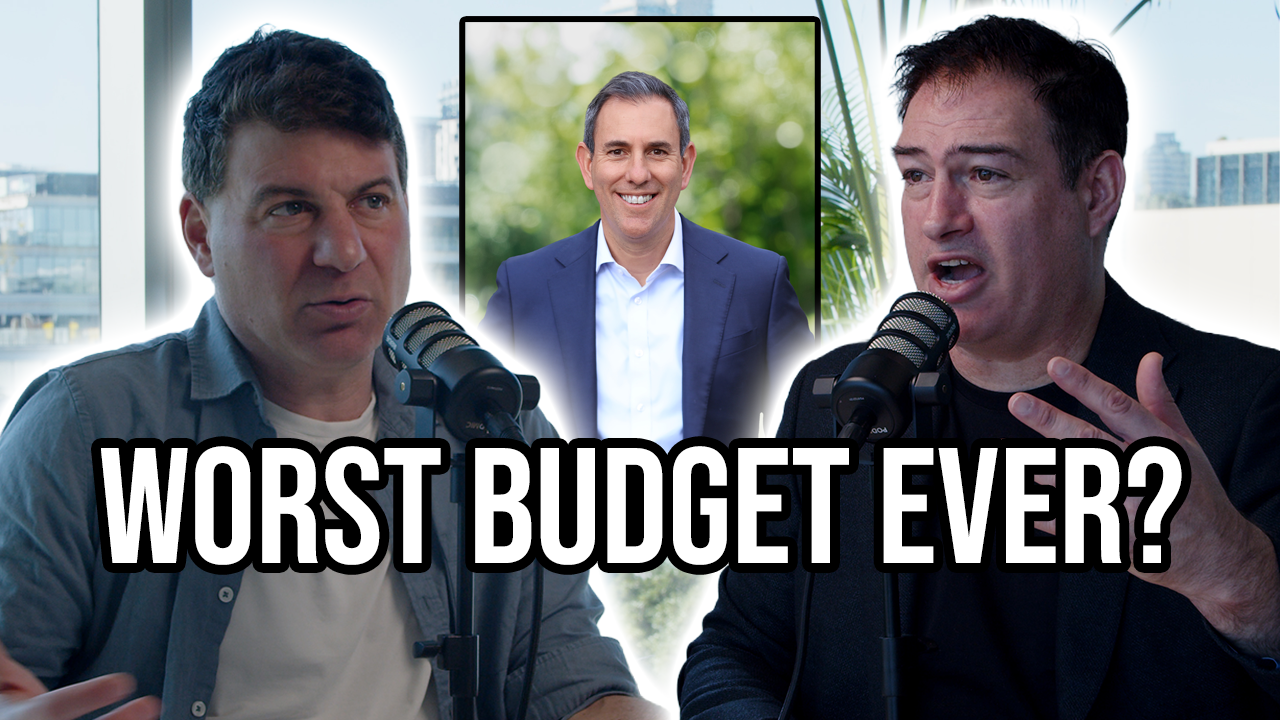
The Contrarians catchup
Adir’s 16-year-old daughter auditioned for the school talent show with a bit where she responds to Adele’s “Hello” as if she’s the other half of the conversation, having been wronged by Adele in a falling out. “It was actually very funny. I’m in a very good mood.”
Adam ran the Mother’s Day run on the Tan, barefoot. His best lap: “About 4:50/km. So it wasn’t my best time, but it was a better time than probably expected.” Adir: “I wouldn’t want to run 3km. If someone said that’s 3km away, my first thought would not be, I’ll just jog it out.”
Adam was in Adelaide for a travel conference and can’t speak highly enough of Peter Malinauskas. “Watching him speak, he came and did it live, no notes, just bang. Imagine if he was prime minister, how good it would be. And we’ve got Albo, that bumbling fool, as Prime Minister. And we got Jacinta Allen running Victoria. Like, could you get a worse situation?”
Adam: “We are literally a socialist communist state in this piece of shit state that Dan Andrews has taken over. And Jacinta Allan has ruined. They should be hanged. Literally, these people are an absolute disgrace.”
Sebastian Sawe ran a 1:59:30 marathon at London, breaking two hours without pace runners or special course conditions. A first-time marathon competitor from Ethiopia also broke two hours and still didn’t win the race. Both were wearing Adidas’s $700 ultralight shoes. Adam: “Adidas share price went up 10% after the marathon.”
Adam’s verdict on the Sam Bankman-Fried investment portfolio: “Sam should have made a VC fund. He shouldn’t have done this crypto thing. Had he done it in a genuine VC fund, he would have been one of the richest men in the world. His problem was his structure. He shouldn’t have stolen the money. He should have legitimately got the money like VCs do.”
SBF’s portfolio is the greatest VC fund that never was
FTX’s liquidated investment portfolio, sold off to repay the ~$10B owed to investors, turns out to have been the most successful investment fund in history, had it been held. The $4.7B invested across six companies would be worth $114B today. The investments: Genesis Digital (3.5X), Robinhood (7.5X), Solana (26X), SpaceX (75X), Anthropic ($500M invested, now worth $82B), and Cursor (seeded at “minimal” cost, now worth $3B, or 15,000X).
Adir: “If we just say out of 10, what’s the hotness factor of these investments? Anthropic, 10/10. Cursor, 10/10. SpaceX, 10/10. Robinhood was super hot and everyone thought it died, but it didn’t. Solana; yeah. Genesis Digital? Well, you thought that was dead. It’s still worth three and a half billion dollars. The guys basically three years ago picked pretty much the hottest stocks in the hottest sector that you possibly could. It is crazy.”
Adam: “I didn’t realise he had Cursor as well. That’s phenomenal. This is like the best Sequoia fund ever. None of them come close to this. Even that great Sequoia fund, it took them 10 years to get there. And they still didn’t get this.”
Adir: “I don’t know what this guy did in a previous life, but he must have done something terrible. Because not only has he gone to prison, but he has to watch this immense fall. This could be one of the richest people on planet Earth.”
Fibre optic drones are a problem
Fibre-optic-tethered first-person-view drones, pioneered by Ukraine, are becoming increasingly dominant on the battlefield. Because the signal travels down a physical cable rather than wirelessly, they cannot be jammed electronically. DroneShield’s entire business model is jamming drones electronically.
Adir: “The reason they use these fibre optic cables is because it means that you can’t jam them electronically because they’re getting the signal down a cable. DroneShield’s business is jamming drones electronically. The rise of this I think means that for the time being, increasingly what you’ll see is DroneShield’s type of technology ineffective against battlefield drones.”
Adam: “I don’t think DroneShield investors think about anything to be honest. I think it’s retail gamblers. It’s Robinhood-style investors.”
Adir: “I would be very interested to hear the new DroneShield CEO come out and explain, is the rise of this fibre-optic based-drone really the future? I’ll be shocked if the answer’s no. Israel is struggling to deal with these drones right now coming from Lebanon. So this is the country most adept at shooting stuff down that’s struggling to deal with it. And if this is the future, what are they gonna do to keep their products relevant?”

Is the federal budget the worst since Whitlam?
Recording the Monday before budget night, Adam and Adir dissected what was being backgrounded to journalists: the removal of the 50% capital gains tax discount on all assets, replaced with an inflation-indexing scheme, combined with restrictions on negative gearing for new investment properties. Both were scathing. Adam called it the worst budget since Whitlam.
On CGT and founders:
Adam: “We already have a very high CGT regime. We have one of the worst in the world already. And they’re gonna double it. The worst place for founders to start their business or to run their business is Australia. Thank you, Jim Chalmers. You’ve made Australia the hellhole of world startups.”
Adir: “If you’re a founder, at least with product market fit, if not starting a business, and you don’t need to be in Australia for running this business, you absolutely should not be a tax resident in Australia growing your business. Go to Singapore. And that has to happen. We have to have a flight of productive enterprise.”
Adir: “If this is what happens, I’m gonna do an Adam Schwab. This is without doubt the worst budget. And there have been some bad budgets. The worst budget of the 21st century.”
On what the tax system should actually do:
Adir: “What you’d want is a tax structure, if you were trying to align risk and return, where starting your own company gave you the most favourable tax treatment, all the way up to your own house. You don’t need great tax treatment for your own house because it’s a pretty low-risk asset. This country exactly flips the risk treatment of the taxation system, to make the most attractive asset your own house, the second most attractive asset an investment property, and the least attractive asset, starting your own business.”
On what happens to renters:
Adir: “There is such a thing in markets called the supply and demand curve. I know this government doesn’t like the idea of supply and demand curves, but if there’s less supply of rental properties, then the price of rentals will go up to the upper limit that people can stretch to pay. And so I think that this is going to be a disaster for renters.”
Adam: “So when I come to an auction, if you can’t afford a house, if you’re a renter who can’t afford a house, see you later mate, because you’re at an auction where there’s an investor and an owner-occupier. And now the investor’s price they can pay is much lower because no negative gearing.”
On who actually gets hurt:
Adam: “It’s like Jim Chalmers has tried to punch this rich guy. The rich guy’s ducked and has punched the poor 21-year-old behind him.”
Adir: “That is a perfect analogy. That is absolutely what’s happened. No young person should be voting for these changes because they are voting against their own self-interest. They will not have the opportunity to accumulate wealth over the next 30 years that previous generations did.”
Five other stories worth following:
Janitor AI, a sexy roleplay chatbot platform, now has 2.5M+ daily users and ranks tenth among consumer AI apps, with some users building wildly elaborate fantasy worlds through detailed prompts and characters.
Gen Z is embracing cyberdecks: custom portable computers built for specific uses, retro aesthetics, privacy and creative control. The trend blends Y2K nostalgia, DIY culture and resistance to Big Tech sameness.
AI chip fever is reshaping markets, with Intel, Sandisk, Samsung and South Korea’s Kospi soaring. Some warn of dot-com bubble echoes, though today’s chip giants have huge profits behind them.
More than 46 passengers left the M/V Hondius in Tenerife after a hantavirus outbreak. Seventeen Americans are headed to Nebraska for evaluation, including one mildly symptomatic passenger and one asymptomatic positive case.
India’s Diet Coke fans are facing a can shortage after Strait of Hormuz disruption hit aluminium supply. Entrepreneurs are capitalising with soda-themed parties, raffles and “Coke-tail” events for desperate drinkers.