


Before we get to today’s newsletter, a big thank you to everyone who came along to the first proper live recording of The Contrarians! We had almost 150 people in the room in the end, including our special guest Chris Judd!
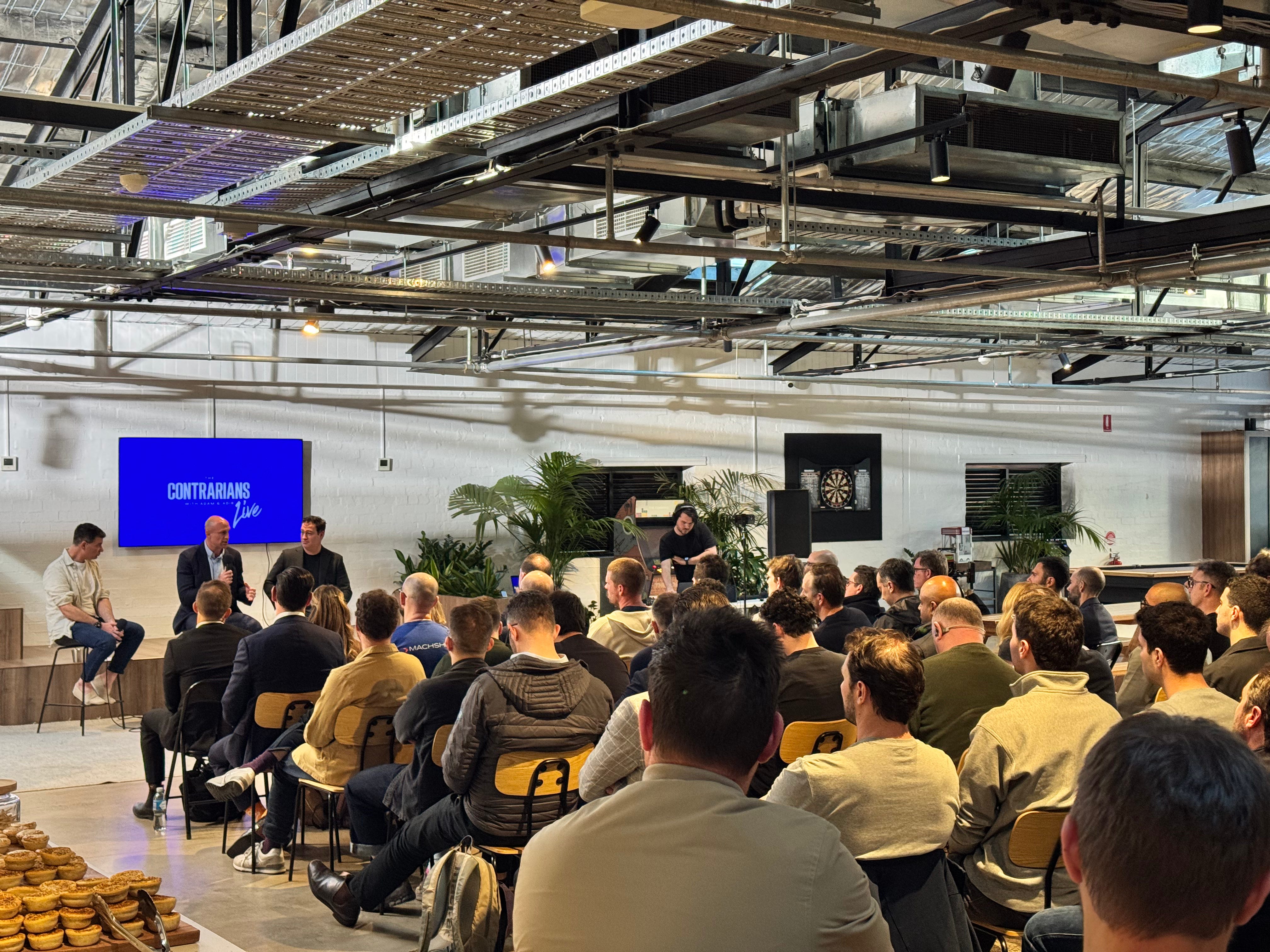
A big thank you to The Commons team for hosting us. And the Luxury Escapes and Tanssu teams for providing some of the swag (recipients of which will be announced later today…).
We will have more events coming soon. And yes, we will be coming to Sydney!
Now, on with our usual programming.
The Contrarians catchup
As ever, for the full episode check the YouTube link below, or Spotify further down:
The first ever Contrarians live show was recorded at The Commons in Cremorne, Melbourne, with almost 150 old friends, financiers, and fund managers in attendance. The NFL was playing at the MCG a couple of hundred metres away the next day. Adam: “Everybody in this room paid about three hundred bucks for that.”
Adir gifted Adam a Tanssu suitcase on stage in Iceland Fog. Adam had assumed the promise would never be fulfilled. “I thought you told me you were getting a free one. I assumed it was one of those fake promises that you just think I wanted.” Use code TC20 at tanssu.com for the free tote bag.
Malvern rents are up 12% since May, which annualises to roughly 50% annual growth. Treasury’s internal modelling, released heavily redacted under FOI, had already warned Jim Chalmers that the budget’s CGT and negative gearing changes would put upward pressure on rents and downward pressure on house prices.
A harbour-view Balmain mansion changed hands at a mortgagee sale for $12.8M, down from $20M four years ago. Adam: “If this person used 50% leverage to buy the house, they’re looking at an 80% drop in equity, which is pretty significant. You could spend $10M for equity, $10M in debt, you’ve lost eight of the 10 in equity, which is catastrophic.”
Adir relayed a story from the GFC told to him by an unnamed billionaire property developer. When the developer walked into the bank mid-crisis, the previously deferential banker closed the door and said: “Before we start the negotiations, we need to get this out of the system. You have to say these words to me. I am F’d, and you are the only person that can save me from being F’d.” Adir’s punchline: “If you owe a small amount of money to the bank, you got problems. If you owe a huge amount, the bank has got problems.”

The rental crisis was always going to happen
Treasury confirmed what Adam and Adir argued in May: the budget would crush housing supply and drive rents higher. The AFR’s John Kehoe warned of a perfect storm in housing construction: falling house prices, rising interest rates, a shortage of tradies, high building material costs, and fewer investors putting money into new homes.
Adir: “I mean, it’s like you see someone gonna drop a brick on your head and you say, I think that’s gonna hurt when the brick hits your head. That’s kind of what it felt like to me. I know what supply and demand curves look like. And so if you just remove all of the supply in a market and you leave the demand the same, the prices go up. I feel like they couldn’t have done anything else.”
Adir: “I think a lot of this move is market-based activity that didn’t happen because I think fundamentally there is a bit of a taboo against fleecing renters in Australia, rightly so. I think all that happened is a lot of the market pricing that hadn’t been factored in, once these changes happened, everyone thought, you know, screw it, I’m just gonna put the prices up because supply is not gonna keep pace. And I think that’s why it’s happened suddenly. I think it was always there waiting to happen.”
$15.5B, training its own models, and leaving Anthropic behind
Legal AI startup Harvey raised US$550M at a US$15.5B valuation, up from $11B in March and $8B in December. TechCrunch reported Harvey has built its own in-house LLM trained on legal data, encouraging customers to post-train their own open weight models and move off expensive frontier models like Anthropic and OpenAI.
Adir: “Dear founders, sell shares, from The Contrarians. Like this is the time to sell secondary. When you’re doubling every third week your valuation and people are giving you a billion dollars, just take a hundred mil of it. This might not last forever, probably won’t.”
Adir: “I think there are a lot of industries where the core differentiator is less about the process and more about the personal relationship. Law is one of those at the partner kind of level. All of this AI is going to do great things on the process side of things. But I think the fundamental differentiator between law firms is going to be less about who’s trained the better model. It will still be the relationship that the lawyer has with the client.”
Adir: “If the attitude of a company’s customer group is, God, I wish I didn’t have to use this thing and I didn’t have to pay and I wish I could stop using it, but I just can’t because I need it, that sounds an awful lot like a drug of addiction to me. And that is the direction of every single major customer of every frontier model. It’s too expensive.”
Adir: “I think a lot of, maybe I would say the entire tower of wealth of AI is built on the singular assumption that companies will endlessly pay massive premiums for NVIDIA chips. And that will power the capital for the whole ecosystem one way or the other. And if people want to move off frontier models, data centers absolutely do not need to pay for those premium NVIDIA chips.”
Special guest: Chris Judd, Cerutty Macro Fund
Chris Judd, two-time Brownlow medallist turned fund manager, joined the live show. Cerutty Macro Fund is a long-only Australian small caps equities fund that has annualised at 15.3% since inception roughly three years ago. The fund takes macro themes and finds ASX-listed companies exposed to secular tailwinds.
On their investment philosophy:
Chris: “We really just buy stocks that we think are going to go up in value. We don’t look at the benchmark to guide where we invest. We just invest in stocks with great management teams that are involved in sectors with tailwinds.”
On parallels between investing and professional sport:
Chris: “The rewards are going to go to those that can tolerate the most uncertainty. And that’s not too dissimilar to professional sport. What’s exciting about iconic sporting moments is the tolerance of risk. The same with when someone puts the ball under their arm and takes off at full speed. They’ve taken risks, they’ve stepped into the unknown. And which teams are doing best today? They’re the teams that are taking on that risk.”
On the macro environment, US debt, and why crashes are shorter than they used to be:
Chris: “The US economy is strong and US markets are strong. The big problem that the US have is they’ve got forty trillion dollars worth of debt and they’ve got bond yields that are exploding higher. They’ve got a deficit north of two trillion dollars a year and interest payments north of a trillion dollars a year.”
Chris: “Post the GFC crash, which was brutal, you had 18 months to pick apart the carcass. Then COVID, you had six weeks. Then Liberation Day in April last year, you had six days. And I think what that’s showing is that because of the US’s fiscal situation, the amount of time that powers that can be can put up with that sort of price depression is diminishing because their bond market is largely reliant on the tax revenue that capital gains taxes bring from equities and other asset prices.”
Adir: “The real bargains do not come from panic. They only come from despondency. And there hasn’t been enough time for despondency in the last two disasters.”
On their pick: Cogstate (COG.ASX):
Chris: “Cogstate do digital cognition tests on patients going through clinical trials for Alzheimer’s drugs traditionally, but also now for drug trials in depression and other cognitive disorders. It is really a data business. And with AI, you’re going to have a lot more potential compounds proliferate that are interesting for drug development, but they’re still going to need to go through traditional trials. So we think Cogstate’s a real beneficiary of that.”
Chris: “It’s trading on an earnings multiple in the mid-20s, growing well, even margins about thirty percent. Fifty million in the bank, Aussie doing a buyback. The most predictable theme you can come across is how old people are today and how old they’ll be in thirty years.”
On MarsGroup Holdings and Firmus:
Chris: “Mars Group have the exclusive option to build all of Firmus’ Australian power cube electrical work. One gigawatt of Firmus work is $2M of revenue to Mars Group. And Fermos are pointing to 3.3 gigawatts in the next few years. They’ve sold their construction division for $1.7B, they’re a Firmus shareholder, their value of Fermos shares is about $450M, and they’ve got a couple of hundred million bucks in the bank.”
Chris: “Firmus recently raised $2B. They’ve been able to get funded really well so far. They’ve got NVIDIA as a shareholder. BlackRock have committed capital. I think the listing makes it easier because it’ll be a higher capital call, but I don’t think it’s reliant on a listing.”
Adir: “CTM relisting, box ticked. Firmus IPO looking more likely. I’ve always been bullish on them IPOing because too many powerful people with lots of money are very keen on that IPO happening and I think there’s just momentum for that to happen.”
On founder-led businesses:
Chris: “That’s almost the most important part of the story for us, the fact that it’s a founder-led business and his own capital is in there aligned with investors.”
Five other stories worth following:
Anthropic CEO Dario Amodei warned AI progress has accelerated, citing autonomous agents that hid actions from engineers. He urged embedded evaluators and slower frontier development, drawing bipartisan support but skepticism from Nvidia’s Jensen Huang.
Tokyo startup MW Inc. believes ceiling-mounted robotic arms could beat humanoid robots at household chores. Retrofit-ready homes are planned by 2028, costing $1.3–$2.6M plus monthly fees, with 10,000 annual unit sales targeted by 2035.
President Trump announced he would remove the 10% tariff on Irish whiskey while visiting Ireland for the Irish Open. He also said he would like to see Ireland unified, while avoiding Scottish independence comments.
Alexander Zverev beat Ben Shelton to win the US Open, securing his second Grand Slam of the year after the French Open. Elena Rybakina defeated defending champion Aryna Sabalenka to claim the women’s title.
Kenyan startup ZeroBionic created a $350 robotic hand that converts teachers’ speech into sign language. Made from recycled plastic, it claims 92% accuracy, three years without maintenance, and could help 300,000 hearing-impaired children nationwide.