


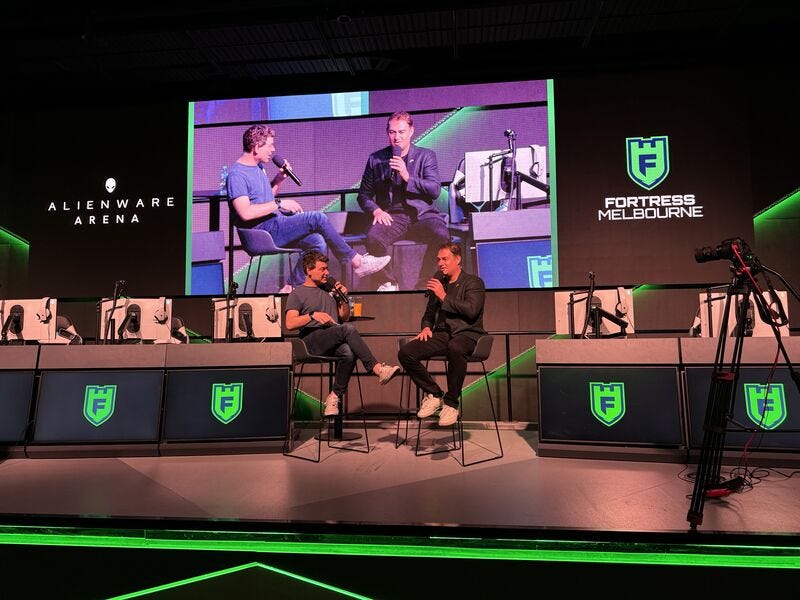
The Contrarians in front of a live audience at Fortress Melbourne.
The Contrarians catchup
Adam was impressed with how he was greeted at a Vietnamese restaurant in Melbourne, but Adir was skeptical about the motive behind the friendliness: “He recognised you as a customer. As in he recognised the fact that you are a potential customer, that was his customer acquisition.”
Adir’s thoughts on hospitality: “it's amazing how many people are running businesses in hospitality and they haven't worked out that the word ‘hospitality’ is connected to the word ‘hospitable’ and it's a horrible experience. You have to make people happy.”
Adir ordered an Uber from Gold Coast airport (“the friendliest airport in the world”), but he went off-app because of a good experience with an Uber driver from a previous trip who gave him his business card.
Adir’s friend received a personalised video message from Richard Branson for their birthday and he didn’t think anyone would believe it was real, given the rise of deepfakes. Adir’s “extreme” take: “Producing deepfakes of real people should be a criminal offense punishable with a custodial sentence”.

TripADeal cashes in
Online travel company, TripADeal, was acquired by Qantas, setting off a discussion about whether they’re a competitor of Luxury Escapes (Adir: “Kmart sells a bag and Louis Vuitton sells a bag”).
TripADeal had funding from BGH Capital, a private equity company led by Ben Gray, who bought in during COVID and made 3-4x times their investment when Qantas made the acquisition.
Adir said “the message that I sent you when I saw this last night was you must be very happy about the price that TripADeal just sold for considering where your business sits in the same market and your relative sizes. And it's a good day for you.”

The ultimate guide to EBITDA, with Adir Shiffman
“When companies talk about earnings, it means many different things to different people, and often it just means whatever you need it to mean for the transaction you're doing at the time.
“So the most honest earnings you would say for most businesses is net profit after tax. That means we sold stuff, that's revenue; we had costs, that’s expenses. And then we made some money at the end, hopefully, and then we paid some tax on it, and then we had a net profit after tax.
“In an ideal world it corresponds roughly to cash and you can pay dividends to your shareholders. And that was the happy world of business in 1850, right?
“Some companies look at profit before tax, or PBT. Which just means we've put everything in there but we aren’t taking out the income tax pot because income tax is different in different jurisdictions. And so we want to see how good is the business actually at making money before we get taxed. So that's still easy to understand.
“And so then we say, well, what else can we take out to make it look better? Well, how about financing costs? Because really financing costs, they're not actually part of the business. They're just money that we've borrowed in order to buy assets.
“So if I've got a $2M loan and I pay $200K a year of interest, maybe we should leave that $200K a year in because I could get rid of that $200K if I went to shareholders and said, let's put in another $2M, pay off the loan, and then we won't have that $200K a year. And so that's earnings before interest and tax.
“So then how can we make the number even bigger because now we're getting somewhere, right? Well, there's this thing like called depreciation and amortidation. They're kind of two sides of the same coin. One is where you are pushing down your physical assets that you bought and one is where you are pushing down the value of intangible assets.
“Amortisation is the best of all. Now, this is legitimate for software businesses that build software that are being used and sold to a third party. If you have a whole lot of developers and it is a very large expense in your business and they are building software that is like a fit out in the store, will be used for years into the future, then it would be s mistake to go and expense all of that in the year that incur those expenses.
“This is how much money we've made before we paid tax, before we paid any interest on any debt, after we generated revenue from our assets, but before we paid for any depreciation or amortisation of any of our assets. That’s EBITDA”.

The Reject Shop’s financials
The Reject Shop’s share price and markup doesn't seem to match its financials. If you look at the last six months, the business generated top-line sales of $458M, so tracking almost $1B in sales, with free cash flow around $20M a year. It’s also sitting on a cash pile of $80M, with no debt, yet has a market cap of only $120M.
The Reject Shop has faced competitive pressure from online retailers, Costco, Aldi, and Kmart, “which is incredible business in the general merchandise category”.
Adam: “They’re in a challenging economic environment where customers simply can't afford to buy. They'll just stop buying. As opposed to LVMH who can perform well in good and bad. A bad economic cycle is actually worse for them.
“Warren Buffett essentially looks for is a high return on equity business that is able to absorb more cash and continue to reinvest it profitably. That's the holy grail of business.”

Live interview with Adrian Giles
Introducing Adrian Giles: Executive Chairman & Co-Founder at Fortress Australia, Director at Adslot, Co-Founder at Hitwise.
“I started Hitwise with a business partner, Andy Barlow. Our first business was an SEO company and and before that, I actually worked at what became Atari, a company called Beam Software and built their games website. It was the first SEO company in Australia and I walked up what we called Bullshit Boulevard, which was St Kilda Road, where all the ad agencies were and started selling this concept of websites to the top of a search engine, which no one understood what this meant.
“It wasn't that difficult back then. It was pre-page rank and all the different things that required are required now from Google's point of view, it was basically just the way you coded the HTML and what you put in the meta tags and what you put in the title tag and the keyword density that you had on.”
Listen in to the launch of Fortress, where the first live episode of The Contrarians was held.

Listener question: How did the guys learn so much about corporate finance, accounting, and economics?
Adir: “My answer is books. I've got no good answer. I think you can learn almost anything in life through being very curious about it and then buying and reading books. I say ‘almost anything’ - maybe don't take out my appendix by reading a book. When I'm reading a book by someone, the way I think about that is that this person is sitting down with me one on one and just talking to me about the most significant, consequential, important knowledge they possess because that's what they put into a book.”
Adam: “I’ve probably read about 500 business books. I basically ran out, there are only so many good business books. I find actually podcasts are fantastic - Acquired is probably the best podcast, other than ours, to get deep business info. I listen to The Prof G Pod with Scott Galloway and Pivot a lot. Freakonomics I really like because of that economic perspective.”

Five other stories worth following:
Microsoft is officially delaying the launch of its new Copilot+ Recall feature, now set to come as a preview feature available initially to testers in the Windows Insider Program.
Sam Altman has privately revealed that OpenAI is considering transitioning its nonprofit governance structure to a for-profit benefit corporation.
McDonald’s is removing its AI-powered drive-thru ordering system tested in over 100 restaurants following viral videos showing customer frustrations and technical issues.
Tesla shareholders are suing Elon Musk for diverting talent and resources to xAI, citing a breach of fiduciary duties and unjust enrichment.
Big tech’s AI-fueled rally has added $3.8T to the sector’s market cap this year. Nvidia, Microsoft, and Apple combined are now worth more than the entire Chinese stock market (excluding Hong Kong).