


The Contrarians catchup
Adir says the state of Melbourne’s roads is so bad that when you drive around, you can’t watch the traffic, you need to watch for potholes. Adir hit one and completely damaged one of his car wheels.
A plug for the Bowers & Wilkins Px8 Over-Ear Noise Cancelling Wireless Headphones, which the guys got from Videopro.
Adir clarifies the difference between ‘uninterested’ and ‘disinterested’: disinterested most often means "not biased," whereas uninterested means "not interested."
Adam attended The Australian 60th Anniversary event and described himself as being in the “bottom 2%” of influential people there. Adir: “I’d hate to be in that room, I can’t believe you went to that”.
Adam held a pop quiz for the top 10 most valuable unicorns. Spoiler alert:
#1 ByteDance
#2 SpaceX
#3 OpenAI
#4 Shein
#5 Stripe
#6 Databricks
#7 Revolut
#8 Fanatics
#9 Canva
#10 Epic Games

Apple’s cheeky market power flex
Adir raised a cheeky way that Apple makes money through its App Store. Most people know that Apple takes a 30% cut on all apps sold through their marketplace, but many don’t know that Apple takes up to 60 days to pay out the 70% to tech companies.
Adir: “So what you have is all of these fast growing apps, that have got all of this money that has been paid to them, that is being held by Apple effectively is an interest-free loan on their balance sheet. So maybe some apps have special terms with Apple. But I can tell you that small, very fast growing apps, they just have to figure out ways to fund their working capital while Apple is holding money that they owe to them.”
Adam: “I don’t see how this is even good for Apple because all they’re doing is crippling apps that make Apple more money. So it just seems counterintuitive to be wielding such power so flippantly against the interests of your own business.”
… and then there’s Google
“Speaking of price gouging and misusing market power, I think Google is probably worse than Apple,” Adam said.
Google is known for owning both sides of its advertising marketplace and effectively controlling how much you pay, but now they’ll also be controlling how you pay by no longer allowing credit cards. Adir’s first thought is the impact on travel “because the whole world is travelling on frequent flyer points from Google spend.”
Chatting with John Stensholt in Paris
John writes about Australia’s most successful and wealthy entrepreneurs, and the business of sport for The Australian, and joined The Contrarians live from Paris.
John takes us behind the scenes of his first few days at the Olympics: the athletes ran out of milk in the athletes village because there’s an uptick in vegan options in 2024, McDonald’s is no longer an option in the village, “the Olympics have to adapt to Paris rather than Paris having to adapt to the Olympics”, and the backlash of Nine CEO, Mike Sneesby, running with the Olympic torch.
Adir: “As much as we just talk about AI and streaming and tech. Largely, human beings are all about relationships. And when people spend money, especially on above the line media, so not online performance, it's not as measurable as spending money on getting Google clicks. And so there's a certain leap of faith or a certain relationship involved in the allocation of that kind of spend. And I've got no doubt that the subliminal requirement for a quid pro quo, like the monk that gives you the free thing at the airport and then asks for money - I've got no doubt that taking sponsors across and giving them a great time makes them feel some kind of emotional connection, emotional obligation for reciprocity. I'm sure it's good for business.”
Essilor Luxottica's Glorious Monopoly
Global eyewear behemoth, Essilor Luxottica, announced the acquisition of Supreme from VF Corporation for $2.2B. VF also own Vans, The North Face, Timberland, and Dickies.
The founding story of Essilor Luxottica is amazing, with its founder, Leonardo Del Vecchio, starting the business in his 30s and not making company-defining moves (like acquiring Armani and Ray-Ban) until he was in his 60s and 70s. Leonardo oversaw the business until he died at 87, had six children to three wives, famously bought out Sunglass Hut’s retailers because he disagreed with the margins, and helped 10x Oakley’s valuation.
Adir: “What is really impressive about this business is that in addition to playing downstream, they also buy crazy upstream, and not just manufacturing of stuff. When they bought Supreme they also bought this business which is an ophthalmic business, which are these cameras that you see an optometrist that look into your eye and diagnose disease. They just basically think if it's got to do with eyes, we want to own it.”
Dream Team Inflation
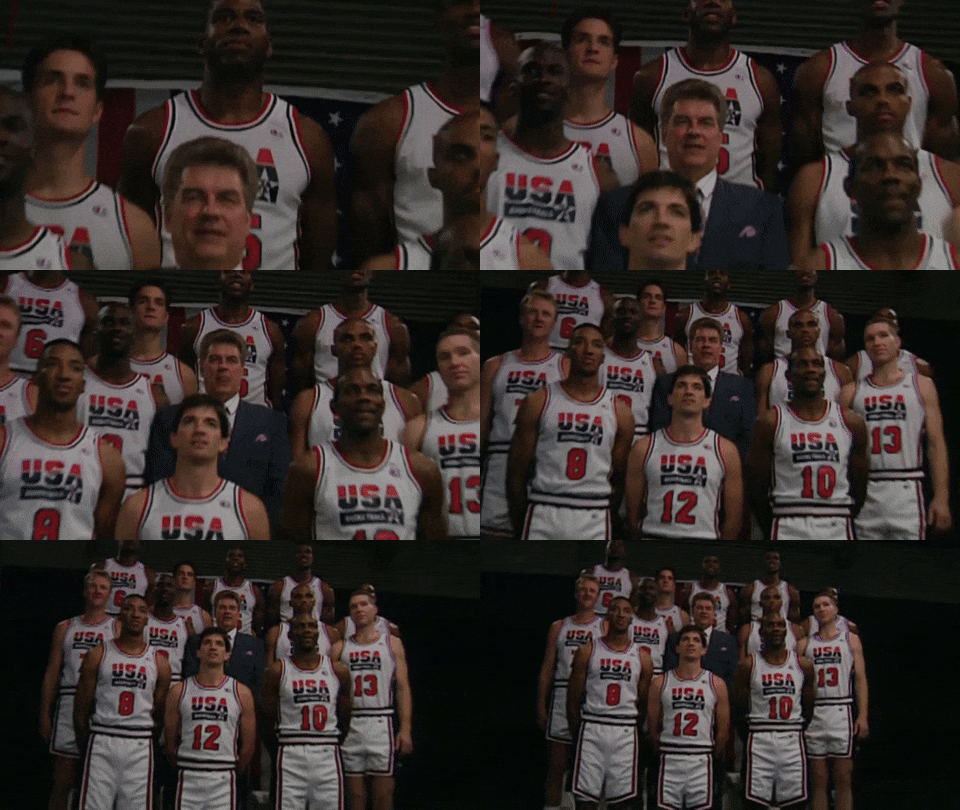
Many believe that the US men’s basketball team at the Paris Olympics is the most talented basketball team assembled since the famous “Dream Team” in 1992, but did you know the combined salary of this year’s team is around 17x higher than the team that dominated the Barcelona Olympics?
Adir: “So the way it works in the NFL, broadly speaking, is that the team owners get to keep all of the money from tickets and from merchandise sales. And that effectively pays the salaries and maybe pay some of the operating costs. And then all of the profitability largely comes from their share of the media deals. And what we've seen is that live sport has become essential in terms of its media positioning because linear TVdoesn’t have much going for it anymore. But what they've got is if they buy free to air rights on, live sports, then people will go and they'll watch linear TV. “
Five other stories worth following:
Amazon, Microsoft, and Meta are all set to report, leaving investors waiting to see whether the trio’s multibillion-dollar AI investments are paying off. Last week Google reported solid revenue growth for ads, but cloud computing was its fastest-growing unit, up ~30% as its data centres powered AI.
In bad news for video game fans like Adir, over 160k video game performers repped by SAG-AFTRA will strike over AI protections for motion-capture actors. They last went on strike for 340 days in 2016 over royalties.
Deadpool & Wolverine opened to $205M at the US box office, making it the eighth-best opening weekend ever and the best for an R-rated film. It already made history as Disney’s first-ever R movie release.
Warner Bros. Discovery sued the NBA after the league rejected its $1.8B/year bid for broadcasting rights. The NBA, which struck TV deals with Amazon, Disney, and Comcast, will split from longtime partner WBD after the 2024-25 season.
The Contrarians discussed how Nike left the door open for brands like Hoka and On after going direct-to-consumer. Deckers reported a 22% YoY increase in Q1 sales, largely thanks to a 30% YoY increase in Hoka sales. Ugg parent Deckers acquired the running shoe brand in 2013.