


The Contrarians catchup
Adam and Adir are both (separately) in Sydney, Adir for a hipages (“the #1 place to connect with tradies”) board meeting.
One thing the guys don’t have contrarian views on is the quality of Cygnett’s products. The Melbourne-based company specialises in portable power banks, mobile accessories, charging cables and car chargers. (This is not an ad, but Adir did get a free power bank from the company’s CEO - “but if I saw somebody using this, I would go out and buy it pretty much immediately”).
Adam and Adir revisit last week’s conversation about the prominence of dyslexia with successful founders and how “neurodiversity is a blessing” despite how difficult it can be for the individual, especially at a young age.
Adam thinks the way that ticketing companies pressure you to purchase tickets within such a small timeframe cannot be legal. His wife purchased Katy Perry tickets and ended up paying way more than expected because the price wasn’t shown until after she’d sat in a digital queue and the timer had already significantly counted down.
The guys talk about the genius acquisition of Chadstone Shopping Centre by John Gandel for $37M (it’s now worth over $6B). Chadstone used to be owned by the Myer Emporium.
Adam and Adir are both perplexed why DVDs still have so much shelf space at stores like JB Hi-Fi. Who is purchasing movies on DVD? (Seriously, we want to know).

Adir’s lesson on income statements and capitalisation
Adir: “When you are running profit and loss accounting, or what's called an income statement, you're trying to say the objective is to match the income that you get from sales with the expenses that you incurred in that period, in order to sell and service the customers. That's the objective of the income statement.
“And in software businesses, you're constantly employing these developers to build software that is going to be used for much more than just the current period. And and so if you spend $10 million this year on software, the argument is from an accounting point of view, that the software that just cost $10 million to build, it's going to be used in future years as well. And so you should be reflecting some of that expense in the future years, when customers in future are paying to use that software.
“And so what you essentially do is you say instead of incurring the whole $10 million as an expense this year, even though we paid the cash for that $10 million, we're going to put it on the balance sheet, which I always talk about as what you owe and what you own. And, and we're going to say it's an asset. It's like we own it as if we owned a building or a machine.
“And so, like a factory or a machine, over time, it degrades like the quality of the machine degrades. It gets old. And so it depreciates over time. Which means you say each year according to a schedule, it's worth a bit less than it was the year before. And the way it's worth less is it turns into an expense on the income statement. This is not a concoction of the software industry. This is an accounting standard to try to reflect and match the expenses with the income. And so historically software companies have what's called capitalised. That means making the expense an asset on your balance sheet. So, a capital asset. And the trick with software is there's some portion of your developers that are building new stuff, and there's some portion that's maintaining existing stuff, and the ones that are maintaining existing stuff, that's just an expense. But the ones who are building new stuff, that’s an asset and you capitalise that on the balance sheet.”

Redbubble/Articore disaster
If you didn’t know, Articore (formerly Redbubble) operates a global online marketplace connecting independent artists with customers, and things aren’t going so well.
Redbubble’s share price was over $7 in 2021, which was almost a $2B valuation under the leadership of then-CEO, Barry Newstead. Newstead was replaced by the founder, Martin Hosking, before they brought in a new CEO, Michael Ilczynski, who was replaced by the founder, Martin Hosking. Since then, the share price has crashed 94% and the entire business is worth around $100M.
Adir: “Redbubble’s problems are many. The first problem they have is their revenue is going backwards year on year. I think it went backwards by ten-plus percent year on year. And so that's not good. And the second problem that I have is that, their gross profit, which they seem quite proud of and I think is, quite dreadful for a business like this, is in the low 40%. And so that immediately puts you in a tricky situation because there is not a ton of money.”
Adam: “Amazon clearly has been competition, driving down how much they can charge for this stuff. So because they don't have the marketing themselves and there's a bunch of other businesses that do this kind of stuff. This competition means they haven't got pricing power. So a lot of a lot of that costs just goes into the COGS. What what what possible forces does it have? I can't think of anything.”

Self-Driving's Big Impacts
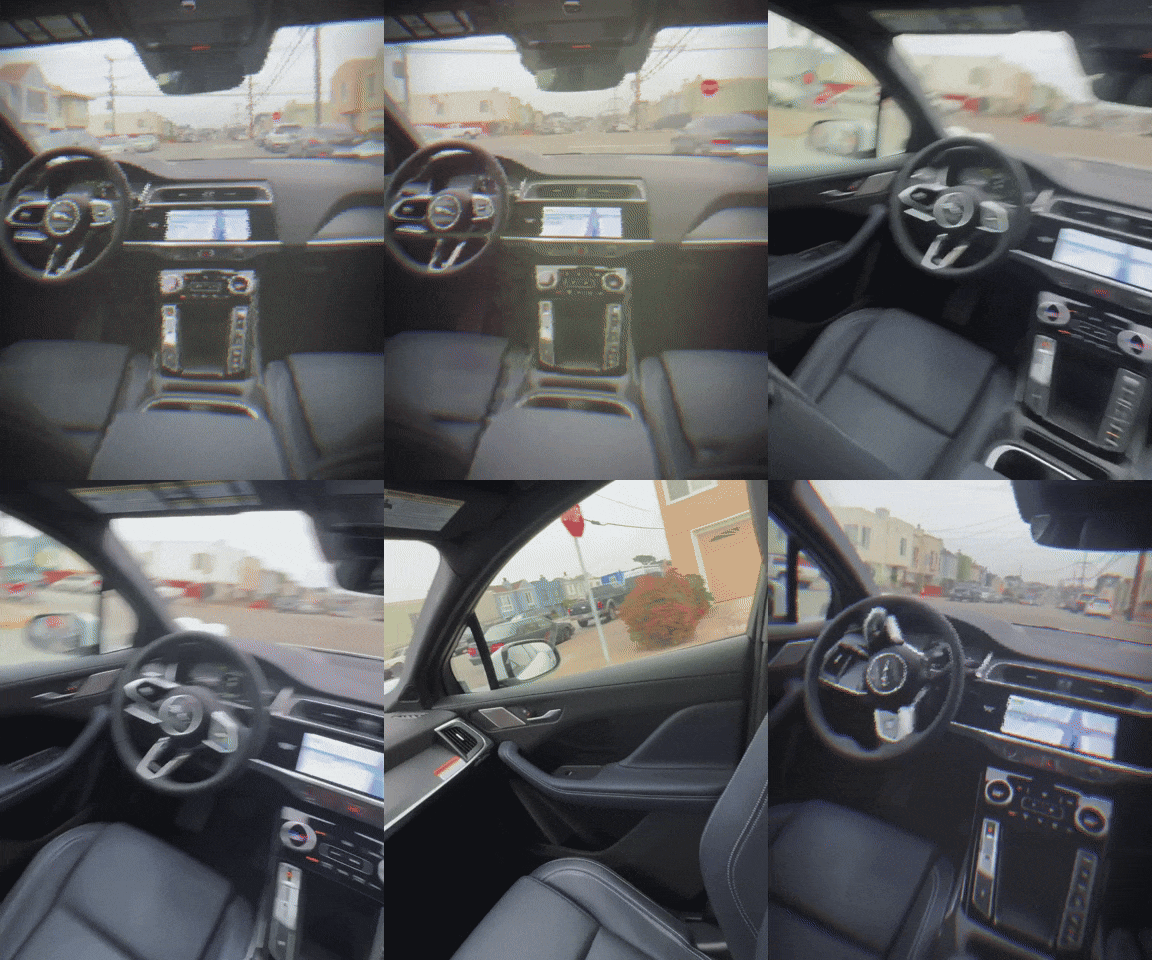
Some interesting data has been released by Waymo, an autonomous driving company that is a subsidiary of Alphabet (Google’s parent company), about self-driving cars.
In June this year, Waymo had 20 crashes; in the same month, the equivalent for human-driven vehicles was 64. Of those 20 crashes, 16 of them were human-driven vehicles crashing into Waymo cars.
Adam: “Australia is massively behind tin this space. We’ve got an increasing problem and no one here is talking about driver-less cars, which completely solves the [road toll] problem.
Adir: “Uber would argue that they have both a network effect and high switching costs. And maybe it doesn't matter who the supply side is as long as it's more than one or two. Maybe the hardest side is the demand side installs. And that's where the magic of the network actually is.”
Five other stories worth following:
SpaceX launched a mission that will eventually bring home the NASA astronauts stranded on the International Space Station. But not for another five months. The pair, who arrived at the ISS on Boeing's Starliner in June, will have been in space for more than eight months.
California Gov. Gavin Newsom, in addition to vetoing the AI safety bill, vetoed a bill that would have required new vehicles to beep at drivers when they go at least 10mph faster than the speed limit.
Megalopolis, the $120M passion project of writer-director Francis Ford Coppola, made just $4M domestically in its debut weekend.
Chinese stocks surged last week after the second-largest economy unveiled a sweeping stimulus push to revive its sluggish GDP growth. China slashed mortgage rates and made it easier for banks to make loans, among other stimulus measures (including cash handouts to the poor).
SAG-AFTRA’s strike against video-game titans including Take-Two, EA, and Epic is in its ninth week. The strike expanded to cover voice and motion performers for League of Legends, which had been exempt from the stoppage because it began production years ago.