


According to the Herald Sun, the only thing that anyone is talking about is the news that Karl Stefanovic has been ejected from Nine following his interview with controversial right wing commentator and campaigner Tommy Robinson.
The consensus view appears to be the following.
Stefanovic has been on a slow rightward trajectory. He has increasingly focused on immigration. He has apologised for his role in encouraging people to get vaccinated. And he interviewed Pauline Hanson and Clive Palmer, before he got round to Robinson. The media in general perceives these as, at best, a slide into senility. At worst, genuine conviction from Karl that Pauline/Clive/Tommy might be worth listening to.
There also seems to be some agreement that this is all some misstep from Stefanovic - he got over his skis, has lost his way, and is now out of a job. If he wants to be “Joe Bogan”, as he has joked, he can’t do so if he excludes half the population.
The Rogan comparison is easy, not least because Karl has made it himself. Rogan is considered by many as the American everyman (despite his fortune). He has at points hosted the biggest podcast in the world and his clips generate millions of views. Karl is building his own Rogan style show which seems similar in format.
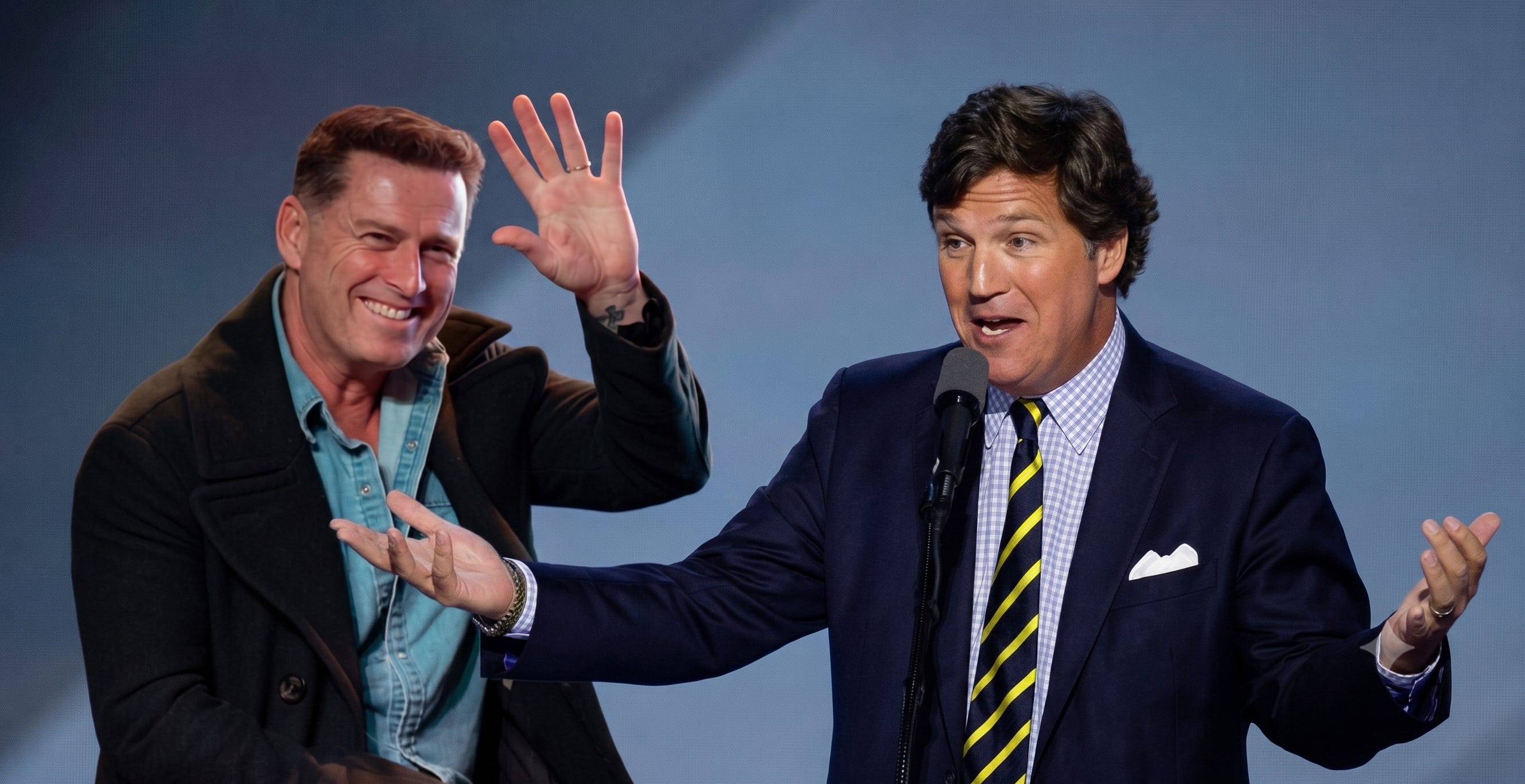
But even if the pun works, it is the wrong one. A far better comparison is Tucker Carlson.
Carlson was famously fired from Fox News following the Dominion settlement, where Fox was forced to pay US$787.5M to settle the claim that they defamed the company (something I became fairly familiar with). It isn’t totally clear why he was fired. In pre-trial discovery, various internal messages showed disdain for the President, Fox’s audience and perhaps most importantly, Fox’s management.
Things have turned out fairly well for Carlson since then.
At Fox, Carlson was reportedly earning somewhere between US$15M and US$20M a year, and walked away from a contract with around US$25M still owing. Within months he had launched the Tucker Carlson Network, a US$9-a-month subscription service, raising roughly US$15M from investors at the end of 2023. By June 2025, Axios reported that he and his business partner had bought those investors out entirely: the network had turned profitable faster than anyone expected, and the backers got their money back with a return.
The audience appears real too, at least on the metrics available. The Tucker Carlson Show was Apple’s most popular new podcast of 2024, and for a week that July it knocked Joe Rogan off the top of Spotify’s US chart. His YouTube channel runs at around 1.7 million subscribers and some 30 million views a month. None of this is Fox-sized — he was pulling 3.3 million viewers a night on cable, the biggest audience in American news — but he now owns the whole thing rather than renting an audience from Rupert.
Exactly how much he is making is impossible to verify; the “$30M a year” figures floating around are guesses. But it is almost certainly a wildly profitable enterprise. The cost base of an operation like this is tiny — Megyn Kelly, who built a similar empire after being pushed out of NBC, reportedly does it with six staff — so even a modest subscriber base throws off more profit than a fat network salary ever did.
The secret is taking advantage of three trends at once.
The first is that you can now reach a massive audience without any of the infrastructure. No studio, no satellite trucks, no network. Carlson’s operation is reportedly staffed largely by the people who used to work for him at Fox, publishing straight to YouTube, Spotify and X. Megyn Kelly’s six-person team now out-rates the YouTube channels of NBC News, CBS News and the BBC.
The second is that the old mastheads and networks are in structural decline, shedding the audiences — and the trust — that once made them the only game in town. This year’s Digital News Report once again showed how much the general public distrust mainstream media (but increasingly trust personality based media). Few in the big end of town ever seem prepared to confront this, other than somehow blaming Facebook and Google.
The third is that there is an enormous audience of people who don’t share the hyper-progressive social politics of most newsrooms, and who feel that nothing in the mainstream is serving them. That is the audience Carlson, Kelly, and Glenn Beck before them, have monetised. The simple fact is, many watch videos like the Karl/Tommy interview and find themselves nodding along.
Could a similarly large and profitable future await Karl?
There are reasons to think not.
To state the obvious, Australia is a far smaller country. This business model relies in part on scale; with far fewer people, and (probably) little chance to become an international star, Stefanovic might just never reach the scale required to build something worth the effort.
But what about the point on hyper progressivism? Ask most people in the media, and in my experience they tend to argue that our media is too right wing. The same people think One Nation and the Liberals are unimaginably evil parties, and Labour is not much better. If you worry about any number of social issues, immigration, or what happened during COVID, you are definitionally evil.
But the general public? With One Nation now polling at 29 per cent, it is hard not to think we’re seeing a radical recalibration of politics in Australia as well.
Might we see something similar coming in media? And might Karl be the media star to capitalise on all this?
Watch this space.