


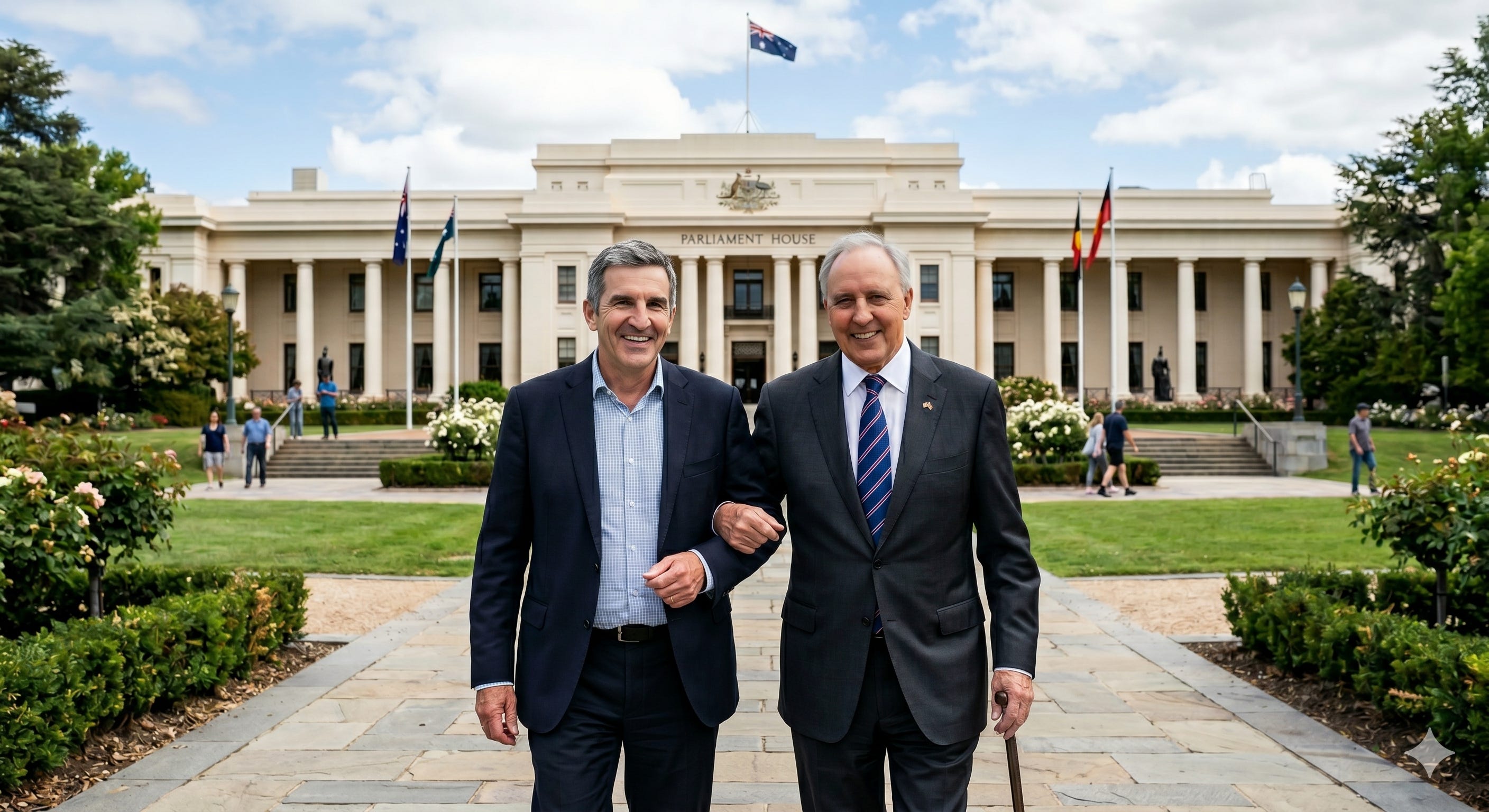
With the Federal Government’s blazing budget dumpster fire showing no signs of flaming out soon, perhaps the saddest scene to witness has been the downfall of two well-known figures, one from politics and the other from big business.
Paul Keating and Daniel Petre both staked their reputations on defending Albanese and Chalmers inequitable budget mess. Neither have come out well.
Let’s start with Keating, once a deeply loathed Treasurer and even less popular PM, whose legacy was justifiably burnished in the fullness of time. Keating’s accomplishments were extensive – from floating the dollar, to deregulating the lazy banking and aviation sectors, to removing tariffs, the ACTU Wages Accords and the Disability Discrimination Act.
Alas, Keating is now more like a 20 year-old former champion racehorse en route to the knackery than a respected elder statesman. His intervention in the CGT debate (and his suspected role in the maligned policy settings) has capped off the downfall of his once great, legacy.
PJK rambled:
“The simple fact is that income is taxed too heavily while capital is taxed too lightly…John Howard and Peter Costello thought they could do their used car selling and dodgy accounting mates a favour by jacking a 50 per cent discount on to the taxation of capital profits – destroying the inflation discounting system I had set up to tax the ‘real’ gain only.
And that distortion has made housing unaffordable for a whole generation. The point is, a society that fails to house its children is a society in decline – this is what Jim Chalmers and his prime minister are seeking to arrest.”
Keating seems to have forgotten his own CGT policy was very different from Jim Chalmers’ Frankenstein legislation. Chalmers’ CGT has a 30% minimum, regardless of what tax bracket you’re in – Keating’s did not. Also, Chalmers neglected to recognise that CGT event will force multiple years of income into one year - the erudite Keating shrewdly adjusted for this with a five-year averaging mechanism.
Chalmers’ policy is so bad it’s even managed to be misogynist as well.
As Mint Partners founder Genevieve Taubman noted: “it is already harder for women to access capital, secure loans, raise investment, and attract senior talent…many female founders begin with fewer resources, smaller networks, and more family responsibilities than their male counterparts. The proposed CGT changes would make an already difficult path even harder.”
Keating would effectively compare these brilliant, risk-taking female founders to “used car selling and dodgy accounting mates” - as if that’s literally the only type of entrepreneur the old man thinks exists.
But leaving aside the sexism, we also have the hypocrisy.
Keating neglected to mention he collected $40m in 2024 year from the sale of Boost Telecom to Telstra. He paid a maximum 23% of CGT on that windfall – if the shares were in his superannuation, given his age, it’s likely Keating paid far less tax on the $40m. (If that were a young person in five years, they’d pay almost $20m in tax).
Aside from the tax breaks, the former PM also collects a massive taxpayer funded pension of $350,000 annually, has taxpayer funded private staff, a taxpayer funded luxury office in a lavish Sydney CBD tower, a chauffeur driven COMCAR and free business class flights. That’s upwards of $1m a year of taxpayer largesse being hoovered up by this great charlatan who has the audacity to compare young founders dining on ramen noodles to used cars salesmen.
And now we’re at superannuation – alongside sycophantism about China, Keating’s great legacy. Or is it?
A month ago, superannuation was a largely ignored tax rort which served to quietly enrich Boomers at the expense of young people (while having the secondary purpose of making every other Joey-bag-of-donuts index hugging fund manager a billionaire).
Super enriches old people in many ways - when you put money into super you pay only 15% tax (essentially a salary sacrifice) – that massively reduces your income tax level – it has a similar effect to negative gearing.
Then (up to millions of dollars in assets), all your dividends, interest and rental income are taxed at a maximum flat rate of 15% - versus as high as 47% for young people. Even better for Keating’s boomers, they also only pay 10% CGT (versus 30-47% for everyone else). This is for up to $3m in super (which doesn’t include the family home of course which always remains tax free).
The rort doesn’t end there – when you move into the retirement phase, up to $2.1m, you pay absolutely zero tax on earnings. The entire superannuation scheme was already a farce, with younger people being smashed – now with Jim’s great big tax on everything it’s basically legalised theft.
It’s no wonder Keating supports the changes – he amassed upwards of $100 million in barely taxed wealth and will likely pay little tax for the rest of his life - the 30 year old struggling founder, they can pay for PJK’s business class flights.
Now for Daniel Petre, who attacked anyone who dared criticise the plan to make turn Australia into the highest taxing country on earth, claiming:
“I call complete bullshit that founders or employees are saying they are going to move overseas because of tax.
You’ve got your kids in school, you’ve got the benefit of Medicare, you’ve got your degrees in Australia, you’ve got your family and friends, and you are leaving for a seedy tax haven because of about 10 to 15 per cent more tax on your shares? Cool the f--- down and take a Valium.”
Petre seemed to forget he literally left the country to work for the maligned Bill Gates at Microsoft, collecting tens of millions of dollars in the process. Apparently moving overseas was fine for him, but for anyone else, they’re going to a seedy tax haven.
Petre continues to idolise Gates, notwithstanding the Jeffrey Epstein revelations, which is of course his right.
But what isn’t his right is to deny younger founders the massive tax benefits he happily received.
Petre is a co-founder of Airtree, alongside the popular Craig Blair (although Petre appears to have left the business in recent years, taking the unusual title of Partner Emeritus). Airtree has been one of Australia’s more successful VC firms, mainly through its Canva investment, alongside bets on Linktree and Employment Hero. The Canva investment alone will reap Petre personally, potentially, hundreds of millions of dollars (depending on Airtree’s entry price).
The kicker? Petre’s Canva’s investment (and his Linktree and Employment Hero carry) are on his capital account and will be valued as at 30 June 2027 - any gains to that point will receive a 50% discount – that means virtually all of Petre’s upside will be under the lower tax rate.
Petre claimed it was “tone deaf for already wealthy technology investors and entrepreneurs to be so vocally calling for special treatment in a policy designed to make the taxation system fairer for those who had less opportunity to accumulate wealth…I’m just so over rich people who’ve made money complaining about tax rates.”
It’s not just me who noted that a boomer who made literally hundreds of millions of discounted capital gains is so keen to deny the same opportunity to others.
Petre defends these double standards by (often) pointing to his charitable giving. That giving is laudable and more wealthy people should do it - but if I steal $100 from you and then give you $20 the next day when you’re begging on the street for food, that doesn’t make me a good guy.
Aside from the hypocrisy, Keating and Petre appear to have little understanding of the commercial realities facing young founders. The notion of taxing income and capital at the same rate is bizarre. There are many well-known reasons that every country on earth taxes capital at a lower rate of income.
Capital is laden with risk (often going to zero) so requires a higher after-tax return to justify the investment, income is steady and mostly risk free.
Plus capital mostly comes from income that has already been taxed, so there’s the dreaded double taxation effect. Then there’s the disincentive to sell if you’re taxed at too high a rate (which acts a handbrake to new investment and job creation). Finally, capital is highly mobile – if you tax capital too highly, it will simply move to a different jurisdiction.
Keating and Petre represent a thankfully bygone area – where old white men could put young female founders in their place for daring to question their wisdom. It’s time to stop listening to these hypocritical millionaires.