


It is a story that has captivated Melbourne’s establishment: a delicious mix of immense wealth, high society, the AFL (the closest thing Melbourne has to a state religion), and a reportedly very unattractive, somewhat shrivelled, penis.
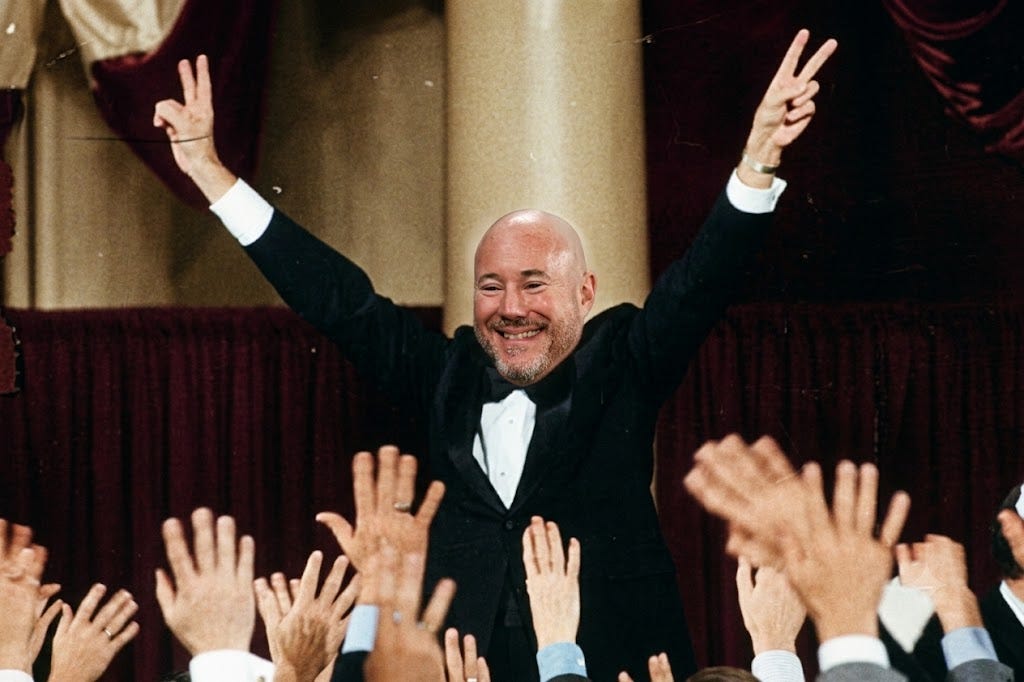
In May 2025, just one year ago, Luke Sayers was riding high. The seemingly Teflon-coated accountant had avoided sanction in the PwC tax leaks scandal and had been fully exonerated by the AFL’s integrity arm in the “dick pic” episode. Rather than keep a low profile, Sayers booked out French diner France-Soir in Melbourne’s glitzy South Yarra to throw a private lunch celebrating his return to Melbourne high society.
Caroline Wilson reported that the lunch was attended by former AFL chief turned Tabcorp boss Gillon McLachlan, embattled St Kilda president and Sayers’ good friend Andrew Bassat (who also bankrolled Sayers’ now near-worthless consultancy business), and Sayers’ own media advisor, Sharon McCrohan (the only female in the room). The loathed former Premier, Daniel Andrews, made a rare public appearance to support his good friend, as did Eddie McGuire and even disgraced former Qantas boss Alan Joyce.
But just when he thought he’d escaped, seven months later, Cate Sayers, Luke’s estranged wife launched legal action that would shock and titillate Melbourne society. Cate accused Luke of deliberately defaming her in legal statements—most notably, a statutory declaration he voluntarily provided to the AFL.
Before he became the defendant in the most keenly followed defamation case in Melbourne society history, Luke Sayers was a high-flying accountant.
Sayers’ background gave no indication of the heights he would soon reach. Born in 1970 in rural Victoria, Sayers studied commerce at Monash University before landing a graduate auditor role at Price Waterhouse in 1991.
Sayers didn’t stay a junior auditor for long. At 25, he moved to the United States and built a consulting practice within PwC’s Washington office—an impressive feat for a kid from country Victoria whose background was as a junior auditor. While in the US, Sayers became a partner at PwC at only 28, which was an exceptionally young age for a partnership even then.
Sayers returned to Australia in 2001, aged 31, and led PwC’s tax division. Seven years later, he was remarkably in the running to lead PwC’s entire Australian business, supported by Paul Brasher, the former PwC Australia chair who had risen to become global Chairman of PwC. (Brasher himself would have a short and unsuccessful stint as Chairman of the Essendon Football Club between 2020 and 2022). Being in the running to run a 6,000-person firm at that age was unprecedented.
Sayers’ initial CEO pitch was cruelled by wiser heads, with Mark Johnson appointed to replace Tony Harrington as CEO. Rob Ward, who had been PwC’s Australian managing partner (before moving to a global role), noted that “Luke was a talented guy, but in a hurry.”
However, as the AFR reported, even back then, Sayers’ behaviour was becoming a problem. Edmund Tadros noted that “in 2012, Sayers was personally fined by PwC for behavioural breaches and pre-emptively apologised to a group of female partners for unspecified past behaviour. He was also personally fined during his tenure as CEO over a conflict-of-interest issue.”
The fine was believed to be in the “five to six figures” and related to excessive spending on entertaining clients and staff, including trips to events and dinners at pricey restaurants.
Worse were the more tawdry allegations that were later reported by the AFR which noted that in 2010, PwC partners had been privately raising concerns about an “inappropriate relationship” (consulting speak for an affair) between Sayers and a junior PwC employee. There were concerns about how closely Sayers and the woman worked together, and how quickly she had progressed within the firm. She was in a part of the business under Sayers’ remit as COO and received roles and responsibilities at a pace that seemed at odds with her experience. Sayers denied the allegations.
Despite these controversies, at 42, Sayers was appointed CEO of the $1.4b PwC (reportedly it was a field of one). Tadros reported that in eight years atop the Australian giant, Sayers almost doubled revenue—a feat that, while sounding impressive, was a relatively pedestrian eight percent annual growth.
Sayers was well-compensated for this relative mediocrity, collecting more than $30m in remuneration. (It would later be revealed that during Sayers’ tenure, PwC partners shared confidential Australian Government tax information with clients—this would cripple the firm and force the divestment of its highly profitable government consulting business).
During his tenure as CEO, Sayers was again fined by PwC, this time for secretly participating in a bid to privatise a visa processing business. He was later forced to sell his stake after an internal investigation. The CEO of a blue-chip accounting firm being fined by his own firm while acting as CEO explains Luke almost better than anything.
In 2020, Sayers made his own big leap, creating the eponymous Sayers Group. While $4m a year is nice, Luke knew the real money was made owning the capital, not being the hired help. He funded the firm through money raised from Melbourne’s millionaire Fox family, alongside Andrew Bassat and Andrew Byrnes.
Sayers had a secret weapon: his very close relationship with powerful Victorian Premier, Daniel Andrews. It was speculated that Andrews directed ministers and public servants to send lucrative consulting business to Sayers’ fledgling firm. Andrews himself would not deny the link, with the Herald Sun reporting that Andrews claimed, “I would say he is a friend, yes... but that doesn’t cut across any of the professional dealings I have with him…I very rarely deal with him on professional terms.”
It was alleged that Sayers played a key role in Victoria’s maligned $100b Suburban Rail Loop. The Age reported that Sayers prepared the very first confidential business case for the heavily criticised project in 2017 while still at PwC.
Sayers Group lost its key inside man in 2023 when Andrews surprisingly quit as Victorian Premier, but the tax leaks scandal proved far more damaging. While Sayers escaped without personal sanction, his business was less lucky. Humiliatingly, Sayers’ name was removed from the door, the group was renamed Tenet Advisory, and Sayers moved from Executive Chairman to a largely ceremonial role.
The dick pic scandal erupted into this temporary peace in January 2025, when Sayers’ Twitter account tagged a female Bupa executive in a post featuring his unattractive appendage (the post was deleted thirteen minutes later). This was a major problem for Luke, who claimed his Twitter account had been “hacked.”
There were three feasible explanations for how the now-infamous image appeared:
Someone stole an image of Luke’s penis, hacked his account, and posted it tagging a random person;
Someone who Luke knew, apparently motivated by revenge, accessed the photo of Luke’s penis, then, perhaps suspecting a relationship with the executive, logged into Luke’s Twitter account through a known password and tagged the executive in a public post; or
Luke intended to slip into the DMs of the executive, but being technologically illiterate, mistakenly created a public post.
No one ever seriously believed scenario one was possible.
That leaves scenarios two or three. Scenario three would have been temporarily embarrassing, but in hindsight, far less damaging. (Sayers wouldn’t be the first, nor the last, powerful man caught with his pants down).
Sayers, alongside his trusted advisor (now senior AFL executive, Sharon McCrohan, more on her later), appears to have worked with the AFL Integrity department to ensure that scenario two was accepted and became lore.
What we didn’t know at the time but do now, thanks to Cate Sayers’ defamation application, is that Luke didn’t merely blame a random person for the image; he actually alleged the hacker was his then-wife.
Luke proceeded to allegedly demolish Cate’s reputation (while telling her the opposite, privately). Under the advice of one of Australia’s best-known litigators, Leon Zwier, Luke allegedly accused Cate of suffering from mental illness—including bipolar and multiple personality disorder—and stated that Cate refused to take her medication, implying she was in some sort of psychosis when she made the post. Luke even made the shocking claim that Cate was raped as a school student by her teacher and his wife—an incredible breach of privacy and trust that, even worse, was totally irrelevant.
If the reports regarding the content of the statutory declaration are accurate, Luke not only accused his wife of being crazy but also threw in unnecessary details of her highly private sexual history for good measure. If they gave gold medals for being an all-time flog, Luke would be our generation’s Usain Bolt.
The AFL’s sham inquiry, which appeared to intentionally avoid checking with Cate (presumably because it wouldn’t exonerate Luke), concluded that “on the available evidence” Luke’s Twitter account had been “compromised.” The only evidence the AFL appeared to avail itself of was Luke’s claims. For all its wokeness, when it really comes to protecting women, the AFL’s boys club couldn’t care less.
It has now become apparent that Luke’s statutory declaration (upon which Cate is taking the defamation action) was received by AFL integrity unit boss Tony Keane on January 15—six days before his sworn statement was formally submitted.
This appears to be what happened.
Back in January 2025, when Luke was trying to prove he had nothing to do with the image being posted, the matter was effectively being adjudicated by the AFL (Melbourne’s de facto court of law). To exonerate a club president and pillar of society, the AFL needed evidence. So, Luke provided the stat dec accusing Cate of being mentally ill and posting the image.
Luke’s media advisor, McCrohan, appeared to work in concert with the AFL’s integrity department to fine-tune the document. Joe Aston put it perfectly: “there is a prima facie case to answer that Luke and his advisers co-opted the AFL Integrity Unit in a conspiracy to destroy his wife’s reputation as a necessary by-product of saving his own.”
Even more shockingly, despite being Luke’s closest advisor through this process—Sharon McCrohan—was later appointed by the AFL as its Executive Manager of Corporate Affairs. You couldn’t make this stuff up. McCrohan remains one of the most senior executives at AFL House, reporting directly to CEO Andrew Dillon. That McCrohan remains in this role while the AFL is balls deep (pun intended) in this scandal is remarkable.
As for Luke, his legal response to Cate’s claims raised eyebrows. The most commonly used defence against defamation is that the allegations were true (the ‘truth defence’). If the horrific claims Luke made about Cate are true, the obvious legal move would be simply to rely on the truth defence. But Luke is not doing that; he is defending the action on the basis of qualified privilege—that is, the statements were made in good faith while serving a legitimate duty.
Qualified privilege is a far harder defence to succeed on, especially given Luke voluntarily made the stat dec to clear his own name. The obvious implication here is that Luke’s legal team, led by Leon Zwier, doesn’t believe a truth defence will succeed.
This leads us to Luke’s biggest problem. If the parties don’t settle and Cate wins, it is likely the Supreme Court will have found, on the balance of probabilities, that Luke’s statutory declaration is untrue. Luke is Melbourne’s very own Richard Nixon; his cover-up may end up being far worse than the original act. Lying on a stat dec is a serious offence, with a penalty of up to five years imprisonment.
There is still a possibility the matter settles before it gets to the Victorian Supreme Court later this year (Leon Zwier is the king of settlements) and the police ignore the potential perjury. But Cate is reportedly demanding an apology, which would mean Luke would have to contradict his statutory declaration and expose himself to criminal liability.
One suspects that France-Soir lunch was scheduled far too early.